
This blog post accompanies our recent open-source release of The Exergy Imperative — a complete technical guide to exergy analysis and its role in the energy transition. It is our first contribution to the open-source community, and we hope it helps highlight more clearly about where the real waste in our energy system is hiding.
Every year, humanity produces roughly 600 exajoules of primary energy. We track it meticulously — barrels of oil, cubic meters of gas, megawatt-hours of electricity. We measure efficiency. We optimize. We build dashboards and write reports.
And nearly all of it treats every joule as interchangeable. They are not.
Energy has both quantitative and qualitative aspects to it. Exergy is fundamentally important because it measures the quality of energy, yet it is almost entirely ignored in traditional energy analyses that only focus on quantity.
This is the blind spot at the center of energy analysis today, and it is why we built Exergy Lab around a concept that has been rigorously proven for decades but almost never appears in the investment reports, policy frameworks, or technology evaluations that shape which energy innovations get funded and which ones do not.
That concept is exergy — the capacity of energy to do useful work.
What Exergy Actually Means
Exergy is not a new idea. It has been rigorously defined since the mid-20th century, refined across thousands of peer-reviewed papers, and applied in detailed studies of power plants, chemical processes, and industrial systems. It is taught in advanced thermodynamics courses at every major engineering university. And it is almost completely absent from the energy policy, investment analysis, and technology evaluation that will determine whether the energy transition succeeds or fails.
Here is the core insight in plain terms:
Energy is conserved in every process. Exergy is destroyed in every real process.
When natural gas burns in a boiler, the energy does not go anywhere — the first law of thermodynamics guarantees that. But its capacity to do useful work is largely gone by the time it has warmed your building to 22 °C. The chemical energy of the gas, which could have driven a turbine, powered a motor, or produced hydrogen, is now dispersed as low-grade heat. The quantity was preserved. The quality was obliterated.
The thermodynamic quantity that measures this quality — the maximum useful work obtainable from an energy system as it comes into equilibrium with its surroundings — is exergy. When a hot gas at 500 °C exists in a 25 °C environment, it has enormous exergy: it can run a heat engine, expand against a piston, drive a process. As it cools toward ambient temperature, its exergy diminishes. At 25 °C, its energy is still there — but its ability to do anything useful is essentially zero.
This is why a joule of electricity and a joule of lukewarm bathwater are not the same thing. Electricity can do almost anything — run a motor, split water into hydrogen, heat a building. Lukewarm water can do almost nothing useful. Same joules. Vastly different exergy.
The Blind Spot in Action: Why a "95% Efficient" Boiler Is Actually 6% Efficient

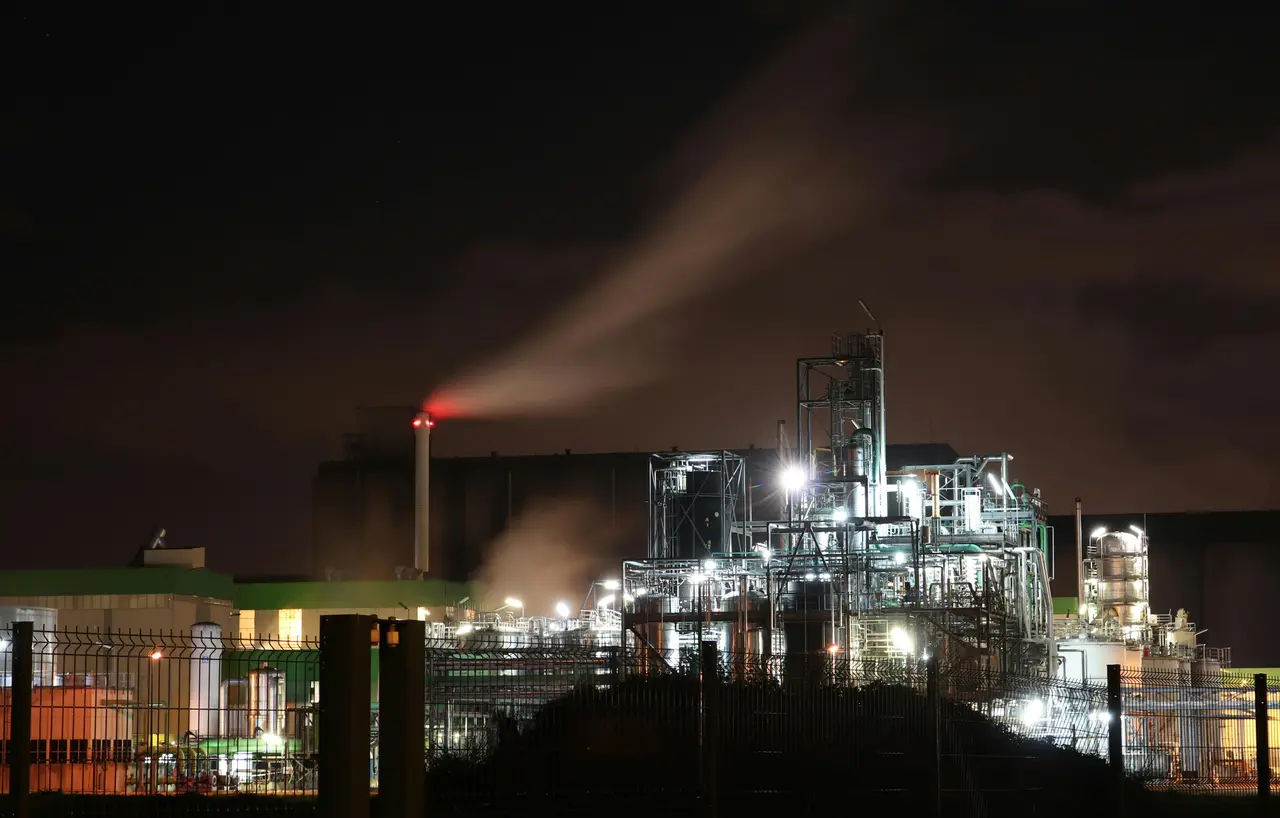
Visible waste — low-grade heat dissipating from an industrial process. The energy is still there. The ability to do useful work is largely gone.
The most powerful illustration of why exergy matters involves the natural gas boiler — arguably the most common energy device on Earth.
A modern condensing gas boiler heating a building achieves a first-law efficiency of about 95%. By conventional metrics, this is excellent. Nearly all the fuel energy ends up as useful heat. The system appears well-optimized.
Its exergetic efficiency — measuring what fraction of the work potential was preserved — is approximately 5 to 8 percent.
How is this possible? Natural gas has a chemical exergy nearly equal to its heating value. It is high-quality energy. When you burn it at an adiabatic flame temperature of roughly 2,000 °C and use the result to warm water to 40–60 °C for space heating, you have consumed energy with a Carnot factor near 0.85 to produce heat with a Carnot factor near 0.05. The combustion itself destroys 25–35% of the fuel's work potential immediately, before any heat transfer occurs. The subsequent heat transfer from flame to water across a 1,900 °C temperature difference destroys most of the rest.
A heat pump doing exactly the same job — delivering the same amount of warmth to the same building — achieves an exergetic efficiency of 30–50%. Same service. Five to ten times less thermodynamic waste. The heat pump's apparent COP of 3–5 is not a miracle; it is what happens when you match energy quality to the task at hand.
This is the insight exergy makes visible: the most wasteful energy systems in the world are often the ones that look most efficient by conventional metrics. The gas boiler's 95% first-law efficiency creates a powerful illusion that masks the 90%+ destruction of thermodynamic quality happening inside it.
The Energy Transition's Biggest Opportunity — and Why It's Hidden
The global conversation about decarbonization focuses heavily on electricity generation — replacing coal and gas power plants with solar, wind, and storage. That work is critical. But exergy analysis reveals that the single largest pool of wasted thermodynamic quality in the global energy system is not in power generation, which has been optimized for over a century, but in industrial process heat.
More than half of all global industrial energy consumption goes to heating. The temperature requirements range from below 100 °C (food processing, drying, space heating) to above 1,500 °C (steel, glass, cement). And the dominant method worldwide remains the same: burn fossil fuels.
The exergetic efficiency of this arrangement is catastrophic for low- and medium-temperature applications. A factory needing process heat at 150 °C, using a natural gas burner with 90% first-law efficiency, achieves an exergetic efficiency of roughly 25%. Three-quarters of the fuel's work potential is destroyed before a single useful thing is done with it.
The alternatives — industrial heat pumps, waste heat recovery, quality-matched heating — can deliver the same 150 °C process heat with exergetic efficiencies of 40–70%. The thermodynamic prize here is not a 10–15% incremental improvement. It is a 50–80% reduction in quality waste for an application that accounts for an enormous share of global energy consumption and greenhouse gas emissions.
This opportunity is hidden in plain sight, masked by an energy accounting system that cannot see it.
Hydrogen, Batteries, and the Art of Quality Chain Analysis

Every link in the energy chain — generation, transmission, storage, conversion — carries a thermodynamic cost. Exergy makes that cost visible.
Exergy analysis also provides the clearest possible framework for one of the central debates of the energy transition: when does hydrogen make sense, and when does it not?
The answer is not ideological. It is thermodynamic.
Every step in the hydrogen value chain — electrolysis, compression or liquefaction, transport, conversion in a fuel cell — destroys exergy. The cumulative destruction is substantial. For a green hydrogen pathway powering a fuel cell vehicle, the end-to-end exergetic efficiency from renewable electricity to wheel is approximately 26%.
The battery-electric pathway for the same vehicle, charged from the same renewable electricity, achieves an end-to-end exergetic efficiency of approximately 75%.
Exergy analysis does not say hydrogen is always wrong. It says: the hydrogen pathway destroys roughly three times as much thermodynamic quality as the battery-electric pathway for personal mobility. Hydrogen must therefore justify itself by serving applications where batteries cannot — long-haul trucking, maritime shipping, aviation, seasonal storage at grid scale, industrial chemical feedstocks. Not by competing head-to-head with direct electrification where direct electrification is feasible.
This is arguably the most strategically important insight exergy analysis provides for energy transition planning. It is also almost entirely absent from the investment theses and policy frameworks that are currently allocating hundreds of billions of dollars to energy transition technologies.
What Exergy Cannot Do — And Why That Matters Too
We want to be clear about something: exergy is not a silver bullet.
A thermodynamically elegant system that costs too much will not be built. A process with excellent exergetic efficiency can still be dangerous. A technology that approaches the Carnot limit in the laboratory can still be decades from commercial readiness. Exergy measures thermodynamic quality, not economic viability, safety, regulatory compliance, market readiness, or environmental impact.
This is precisely why Exergy Lab is not just an exergy analysis tool. It is an workspace for technical questions: a place to bring together source material, explore physical constraints, and make the next decision easier to discuss. The exergy lens is one way the system keeps energy quality visible, but it is part of a broader way of thinking.
We also want to be explicit about where exergy analysis adds no value. For systems where the input and output are both electricity — batteries, power electronics, inverters, grid transmission — exergetic efficiency is essentially identical to first-law efficiency. Computing and reporting exergy for a lithium-ion battery adds no information. It is identity math. The same is true for wind turbines and hydroelectric plants, where kinetic and potential energy are pure exergy by definition.
The discriminative power of exergy analysis emerges precisely where energy changes quality: in combustion, heat transfer, chemical conversion, separation processes, and multi-carrier systems. That is where first-law analysis goes blind, and where exergy can transform decisions.
Why We're Open-Sourcing This
We built Exergy Lab to accelerate the energy transition by helping founders, investors, scientists, engineers, and project developers answer a question that no platform adequately answers today: Is this energy technology ready for the real world?
Answering that question honestly requires exergy-aware analysis. But you cannot evaluate a technology for exergetic efficiency if the people evaluating it do not understand what exergy is, why it matters, and where it applies. That knowledge gap is real. It spans engineering teams, investment committees, policy offices, and startup boardrooms.
The Exergy Imperative is our attempt to close that gap — for everyone, not just our users.
We believe the energy transition will move faster if the entire community of people working on it — not just thermodynamicists and academic researchers, but the engineers, investors, and policymakers making real decisions about real technologies — has access to clear, rigorous, honest thinking about energy quality. So we are releasing this guide as open-source, free to use, share, adapt, and build upon.
This is the first of what we intend to be many contributions back to the community that has generated the science we build on. The exergy literature spans decades of rigorous work by researchers like Szargut, Bejan, Tsatsaronis, Valero, Dincer, Kotas, and many others. We owe an enormous intellectual debt to that tradition. The least we can do is help translate it into a form that changes how practitioners think.
Reading the Full Guide
The Exergy Imperative covers:
Foundations — What exergy is, its components (physical, chemical, radiative, kinetic, potential), the Gouy-Stodola theorem, and why exergetic efficiency is more meaningful than first-law efficiency for thermal systems.
Where exergy transforms understanding — Detailed analyses of industrial heat, CHP, hydrogen, desalination, carbon capture, steel, cement, and aluminum — and honest acknowledgment of where exergy adds no value.
Practical application — A step-by-step guide to conducting an exergy analysis, common pitfalls, and lifecycle exergy (Cumulative Exergy Demand).
Strategic implications — How the energy transition should be designed around quality matching, where hydrogen makes thermodynamic sense, and the hidden opportunity in industrial process integration.
Honest limitations — What exergy cannot do, and how it can be misused.
A practical agenda — Specific guidance for engineers, investors, policymakers, and educators.
It includes worked numerical examples, reference tables of standard chemical exergies, and benchmarks for common energy systems — from combined-cycle gas turbines (exergetic efficiency ~55%) to gas boilers for space heating (exergetic efficiency ~6%) to lithium-ion batteries (exergetic efficiency ~92%, essentially identical to round-trip efficiency because electricity is pure exergy).
We have tried to write it as a guide we wish had existed when we started building this platform: technically rigorous, honest about limitations, and grounded in the real decisions that engineers and investors face.
An Invitation
We are building Exergy Lab to be the go-to platform for validating and de-risking energy innovations — free for anyone working to advance clean energy. Exergy-aware analysis is central to how we evaluate technologies, and we believe making that thinking public makes the whole field sharper.
If you find The Exergy Imperative useful, share it. If you find errors or have improvements, open an issue or submit a pull request. If you are working on an energy technology and want to understand how exergy analysis applies to what you are building, we would love to talk.
The energy transition needs every possible tool for identifying where thermodynamic quality is being wasted — and where, with better design and better decision-making, it does not have to be.
That is what exergy is for and that is what we built Exergy Lab to do.
The Exergy Imperative is licensed under Creative Commons Attribution 4.0 International (CC BY 4.0). You are free to share and adapt the material for any purpose, provided you give appropriate credit.
Exergy Lab gives AI agents real tools for research, calculations, and simulations so teams can do more technical work in one place.